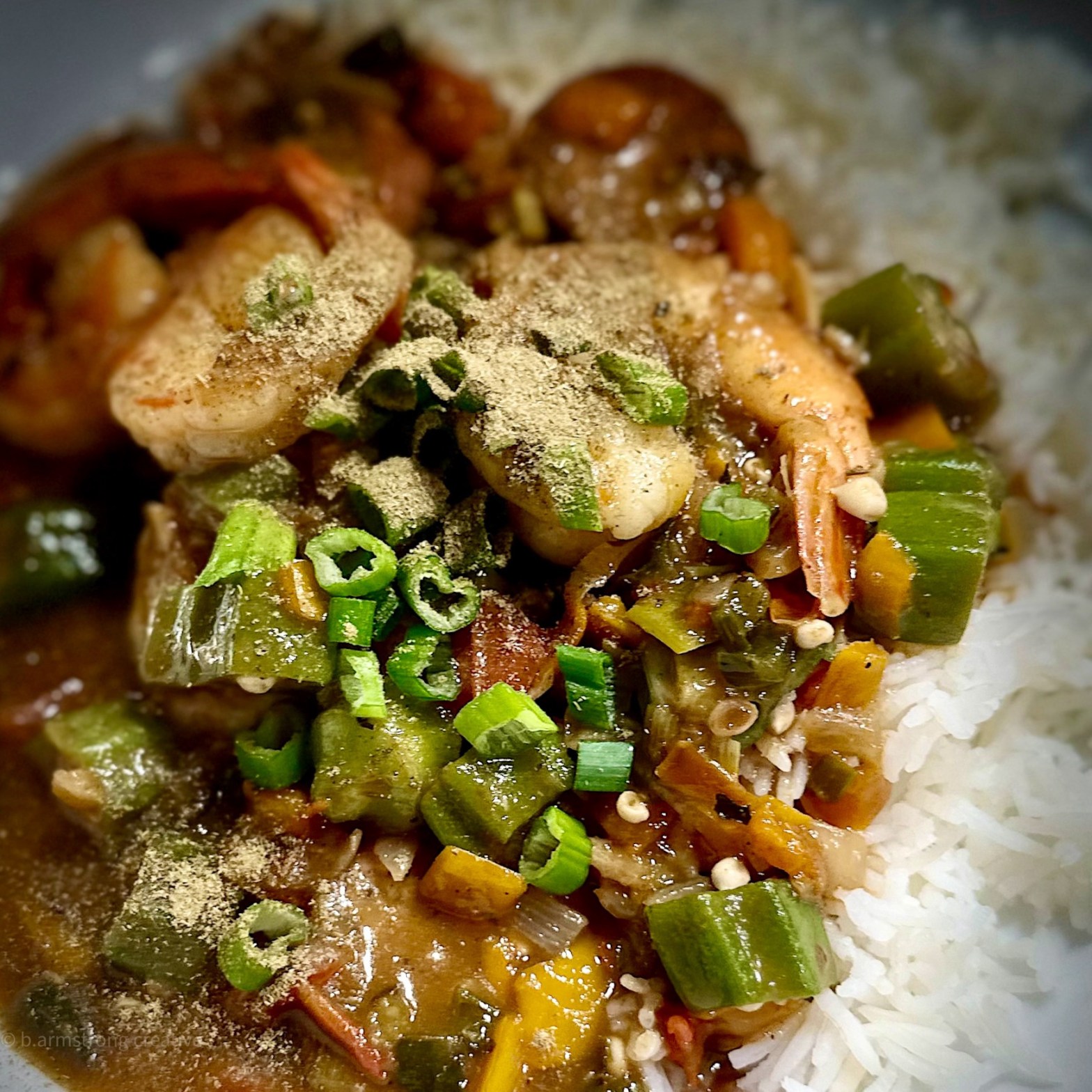
..especially if it’s closer to gumbo.
Y’all know I have absolutely no qualms about eating cold pizza in my car or standing over the sink scarfing handfuls of chocolate cake, but there really is a time and place for a real dining room. There’s also a time and place for self control, but I generally opt out. Besides, dining rooms require far less soul-searching.
While my family spent the pandemic (and much of the post-pandemic) eating on our laps, I honestly love formal dining rooms, especially for special occasions. And since I will make a holiday meal out of nearly any international cultural event I encounter, I long for a pleasing space to gather and dine. A room of extra furniture reserved for mandated quarterly meetings is decidedly not pleasing. And just like that, I’ve waded into one of the design controversies du jour: who needs a dining room? Ironically that pales in comparison to the Cajun v. Creole gumbo debate, which I manage to sidestep later on.
The man who can dominate a London dinner-table can dominate the world.
Oscar Wilde
I suspect Oscar never met a woman who can dominate a dinner table in Atlanta.
Many people have done away with formal dining rooms, reclaiming their unused space to max-out an open floor plan. Indeed, most days an American dining room could be covered in mail or unfolded laundry, the latter of which shifts around the table to make room for a portable office. I can’t say my dining room ever got that kind of traffic; it was just a wide, gloomy hall with unremarkable details, except for a useless, low chair rail that protected nothing from anything.
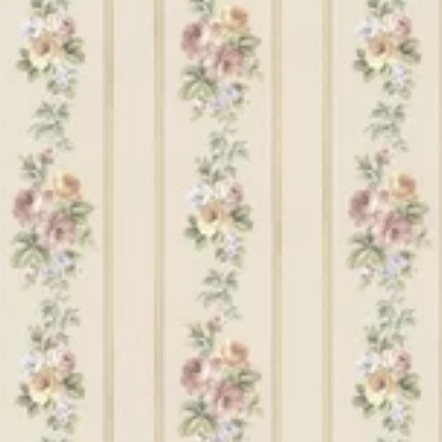
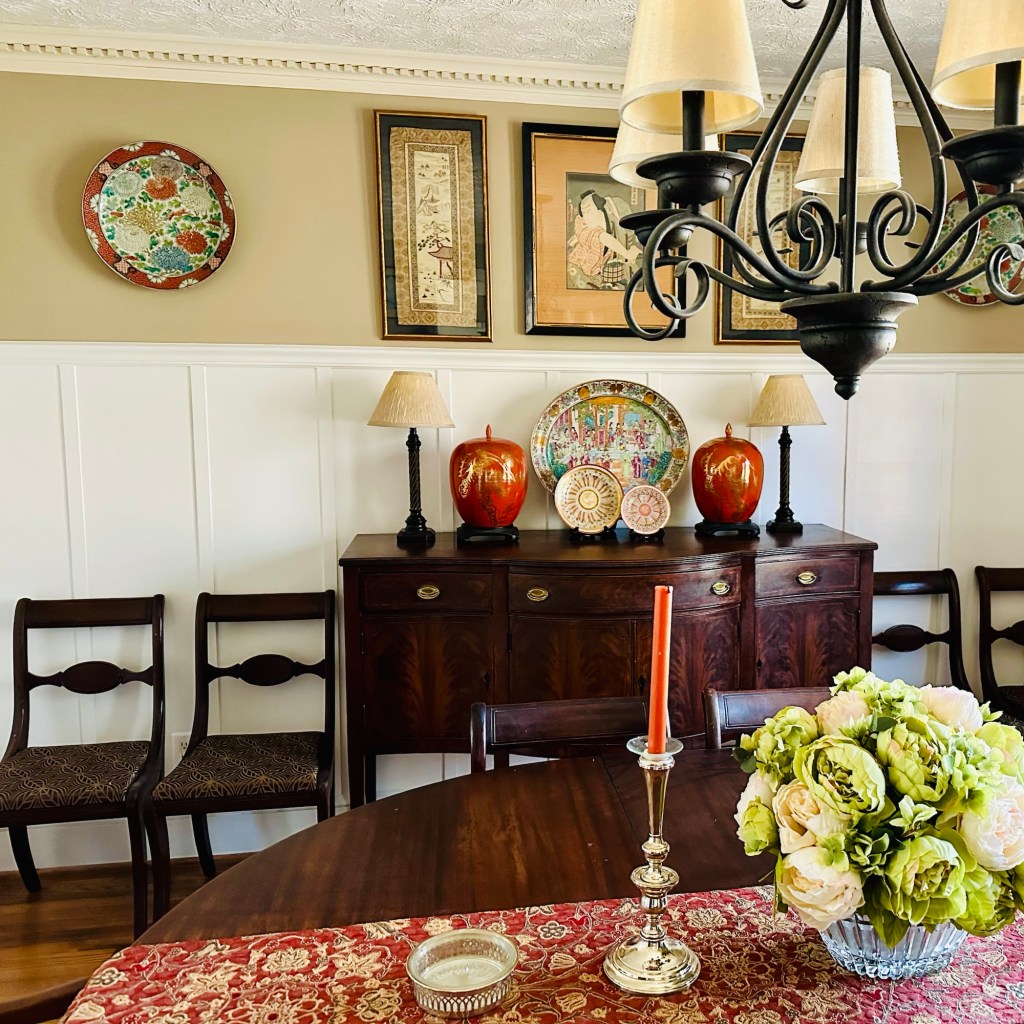
What did I want? Well neither a ghastly, charmless boutique hotel lobby nor a wizard’s lair of mysterious antiquities. Okay, wizard’s lair might be a little closer to the mark, but I simply wanted a light and airy space without sacrificing personal treasures – homey, but crisp. For over 20 years I failed to achieve this criteria, which really is spectacular considering the floral nightmare we bought back in 2003 – it was a very low bar. This time it was more than a paint job. This time I was going to enlarge the perceived space and raise the horizontal sight line 3 feet. This time I needed a hammer. And math.
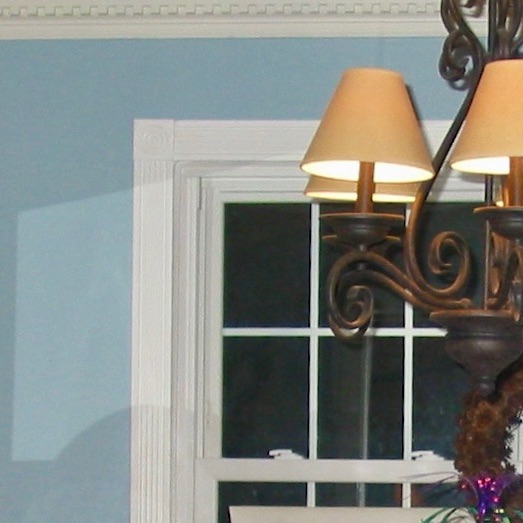

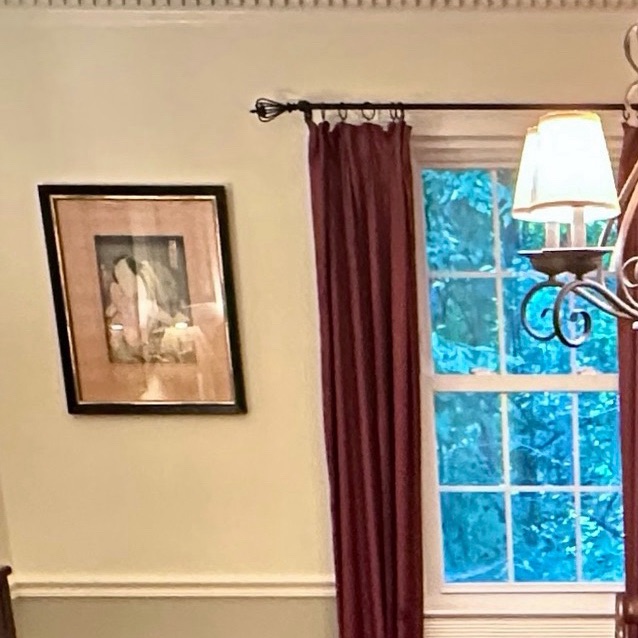
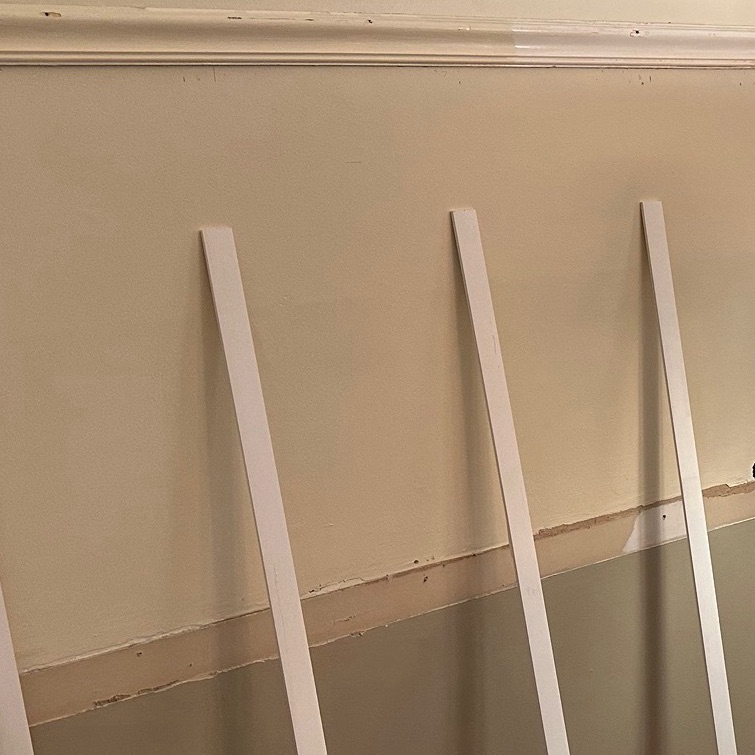
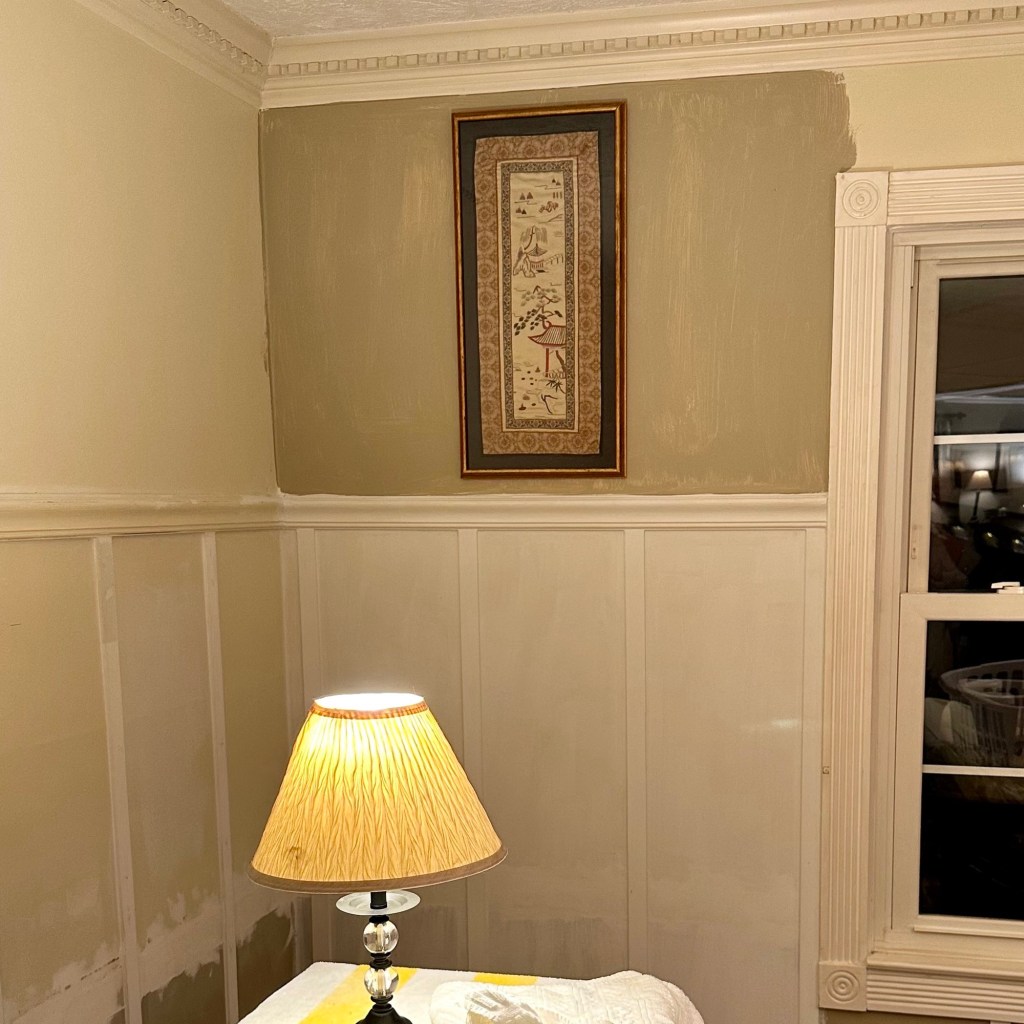
Pre-fab board-and-batten paneling can be purchased and installed in large sections, probably in a day. But where’s the fun in that? Besides, I drive a Honda which can only carry an armful of 8-foot batten strips at a time. Even with mountains of research and my new boyfriends at the local lumber yard, it still took me nearly a month to meticulously craft my vision. That level of patience was very unlike me, a fact I announced every night as I cleaned the day’s mess of wooden shards, bent nails, and dried wads of joint compound. Plus, there was the dust storm. And the caulk…there was caulk everywhere. It was always a mess – and that was very much like me.
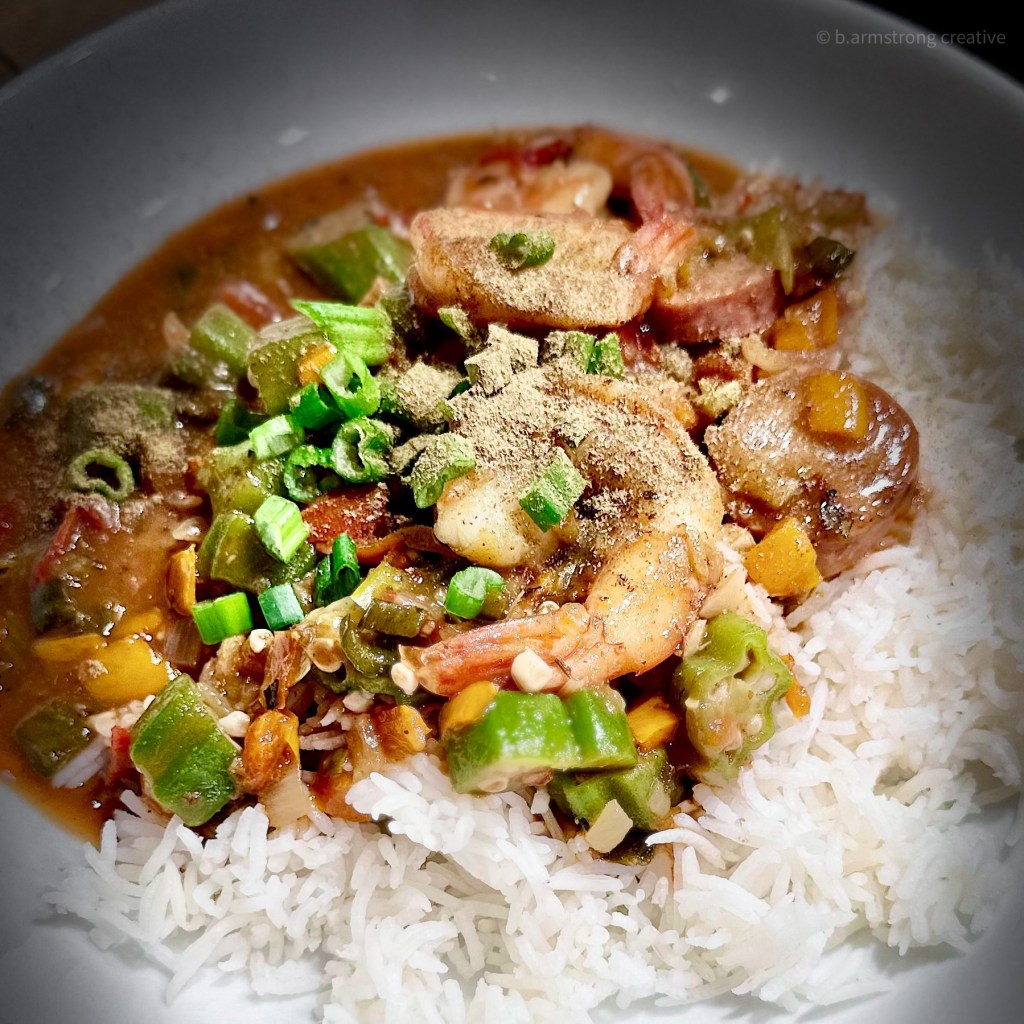
The first meal in the new dining room was leftover Sunday Sauce, probably because I was too exhausted to cook. But our second encounter was shrimp and sausage gumbo/étouffée, a hybrid concoction whose eclectic roots seemed fitting for my eclectic dining room. There was a happy conspiracy to my serving a motley stew in my quirky Craftsman, Victorian, Greek Revival, and East Asian dining room. I can also report that not a single element that night, living or otherwise, was native to Atlanta, but we all fit in according to plan. Through uncharacteristic restraint, my breezy-but-artful wizard’s lair was complete.
Growing up in the South, gumbo on white rice was a fairly routine supper, but not because of any particular fealty to New Orleans. Savannah gumbo was more Geechee than Creole, made from local ingredients on hand: shrimp, onions, celery, tomatoes, and okra. Unlike Creole gumbo, there wasn’t a heavy, dark roux component – it was the okra’s job to thicken the stew. It was practically health food.
It wasn’t until I first went to New Orleans in my twenties that I was bewitched by a deep, buttery roux. Strangely, it wasn’t a gumbo at all, but étoufée. And while this particular demon is characterized by a much lighter roux than traditional Louisiana gumbo, it was still far more decadent than what I grew up on in Savannah. Despite being lauded for their storied pedigrees and enhanced by the mystique of French influence, New Orleans recipes have very utilitarian roots. There’s always room to experiment, riff, and fuse, and these habits have given us a uniquely American cuisine over the years. Since the 18th century, cooks, chefs, and housewives have fiddled around with gumbo, and to them I extend many thanks for the wiggle room.
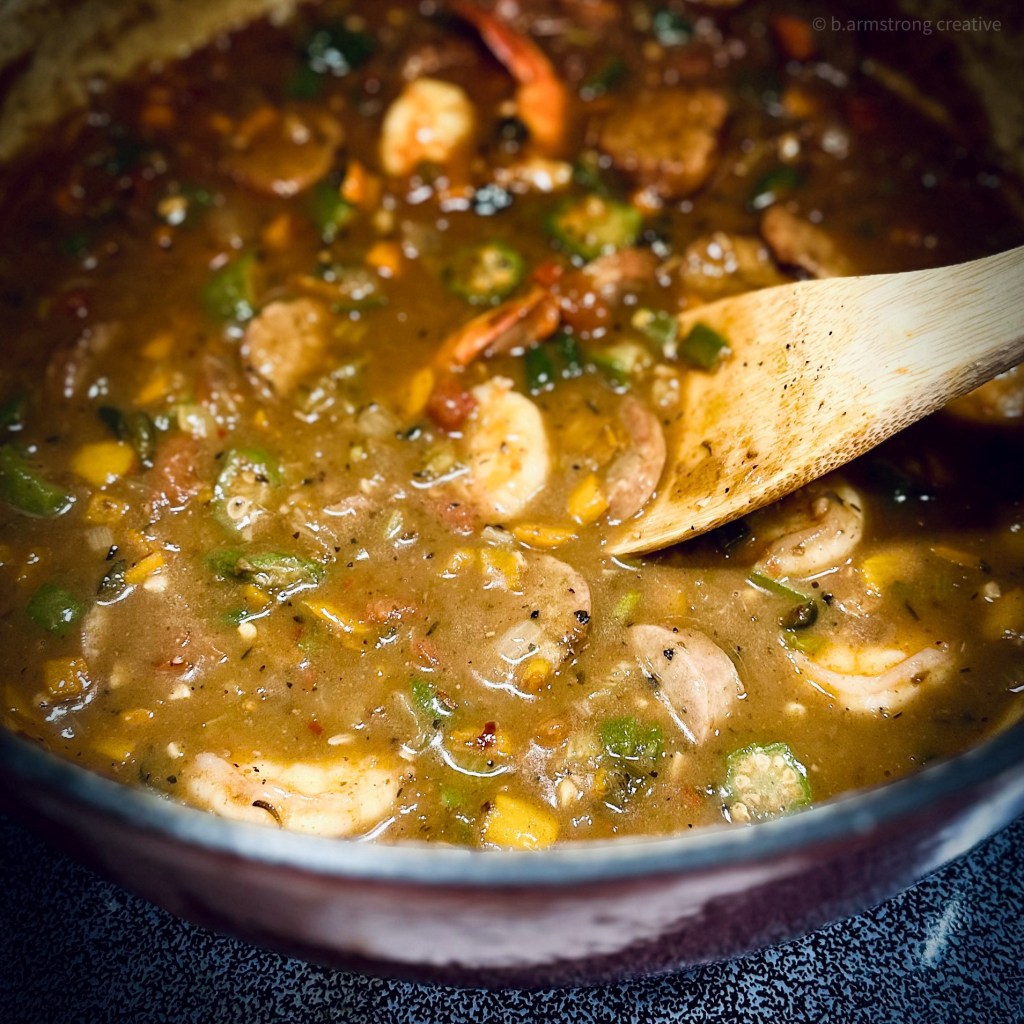
Now, I simply can’t win with the New Orleans purists, so I created my own happy recipe from the jumble of flavors and textures found in rich étoufée and simple Geechee gumbo. By whatever name, these West African/French/Native American/Spanish-inspired recipes are raging sensory parties and all the big names are invited: butter, seafood, sausage, chicken, and the holy trinity of celery, peppers, and onions. So let’s party.
Quick Shrimp & Sausage Étouffée-esque Gumbo
Ingredients (for 2 hungry people)
- 4 T butter
- 3 T flour
- 1 small onion, finely chopped
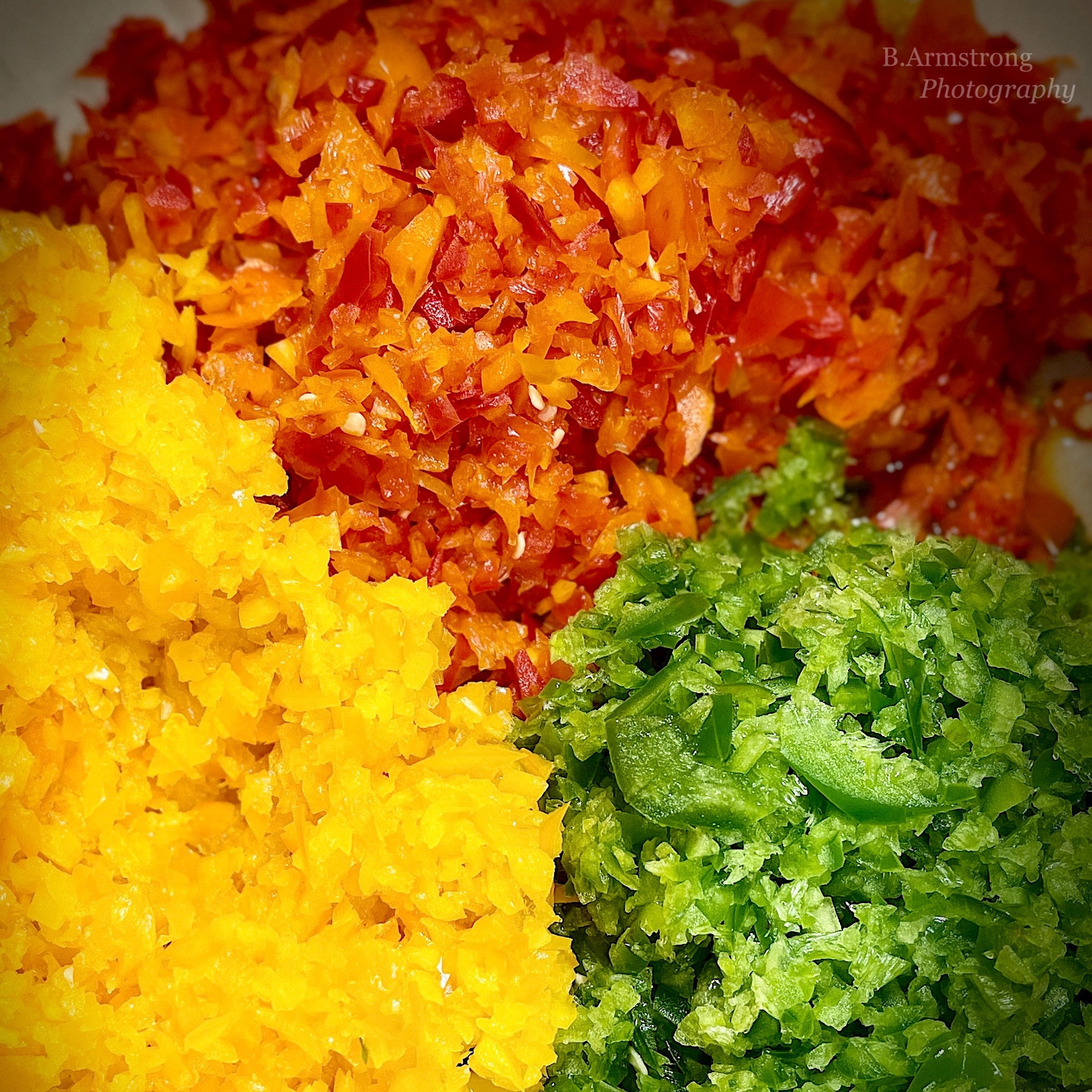
- 1/4 cup each diced yellow, red, and green bell peppers (I used poblanos instead of green because I hate them)
- 1 stalk celery, finely chopped
- 1/2+ tsp Kosher salt to taste
- 3+ cloves garlic, minced
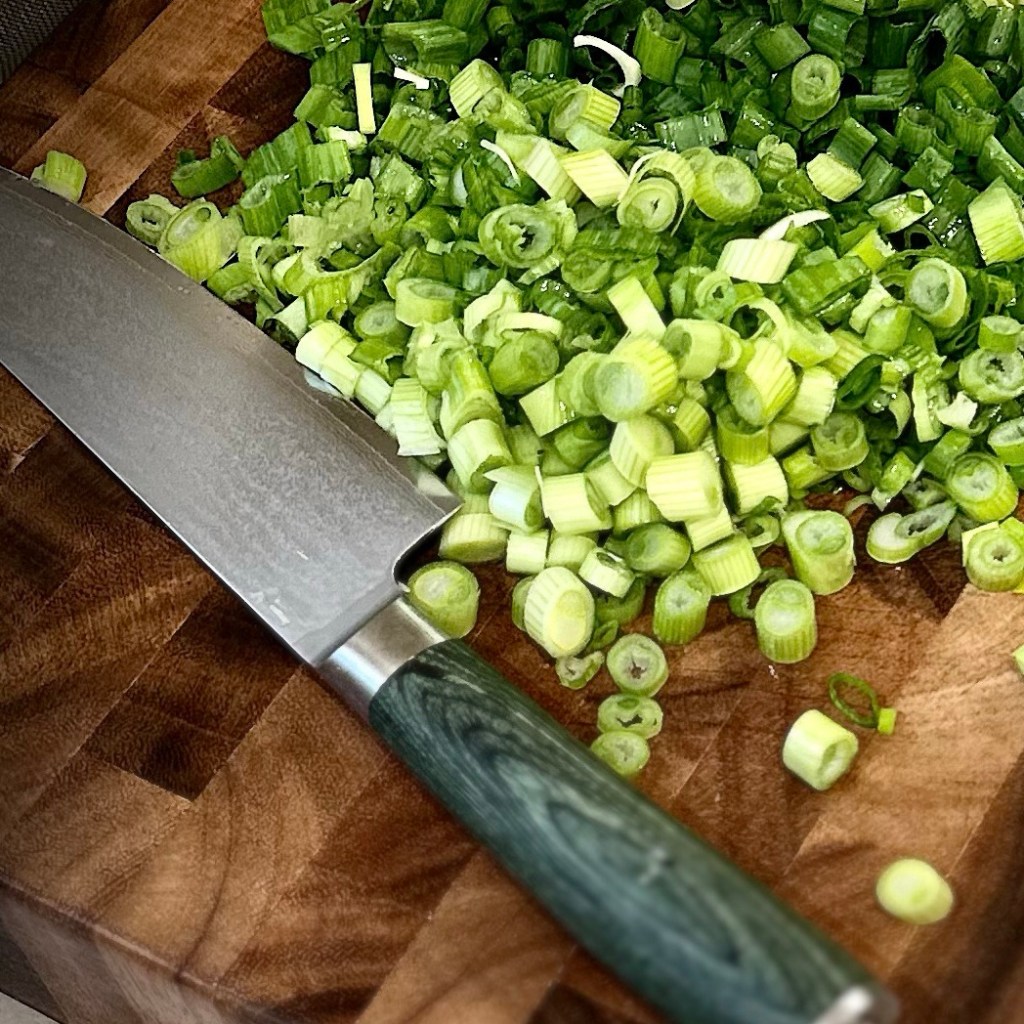
- 6 or so scallions, white and green parts, chopped
- 1/2 tsp each dried thyme, oregano, parsley
- Fresh ground black pepper to taste
- Dash of cayenne to taste
- 2+ cups seafood or shrimp stock, divided (chicken stock is a good substitute)
- 1 bay leaf
- 2-3 cooked sausages, sliced into 1/4” rounds (I had leftover hot Italian that had been grilled)
- 1 cup chopped okra (frozen works)
- 12-14 large shrimp, peeled to tail and deveined

Method
Melt the butter in a Dutch oven over medium heat. Add flour and whisk continuously for 5-7 minutes to create a smooth, golden brown roux.
Add the onions, peppers, and celery and sauté until soft, about 8 to 10 minutes, stirring constantly.
Season with salt and add garlic, about half of the scallions, and the dried seasonings. Sauté for about one minute to release the flavors.
Whisk in some broth, about 1/2 cup at a time, until you reach a gravy-like consistency. This is a matter of preference, so add the broth slowly. Throw in your bay leaf.
Cook the mixture on medium heat for about 10 minutes, stirring occasionally and adding more broth or reducing heat to keep your desired viscosity.
Add okra and sliced sausages and cook an additional 10-15 minutes, making sure to slowly boil down the okra until it’s tender.
Finally, stir in the shrimp and cook until just dark pink and firm. Top with the remaining scallions.
Serve with white rice and plenty of gumbo filé.
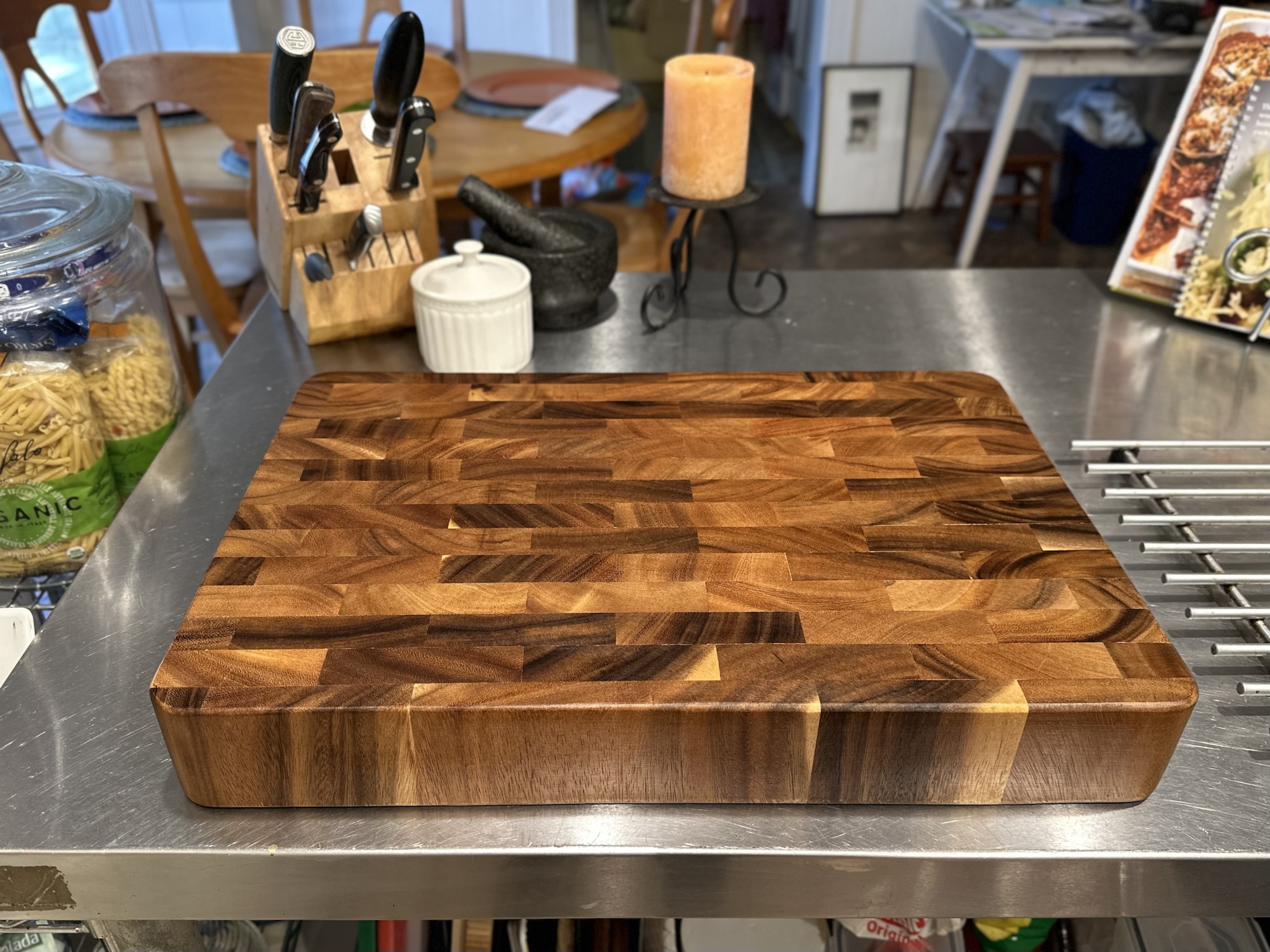
While I’m proud that I was so manual in my construction techniques, after I emerged from traction I treated myself to an orbital sander and a fancy brad nailer. I stopped there because I don’t want too many shortcuts; at least not yet. I need to feel what I’m doing so I’ll do it carefully, learn the skill, and get it right. It’s exactly like knife work – sure I have a mandolin and a mini-prep, but the tactile experience, complete with daily, accidental bloodshed, keeps me actively and meaningfully engaged. Since it was “birthday month,” Husband gave me a wide, fat end-grain cutting board which will keep me honest in the kitchen as well. But I’m totally going to get a circular saw one day.
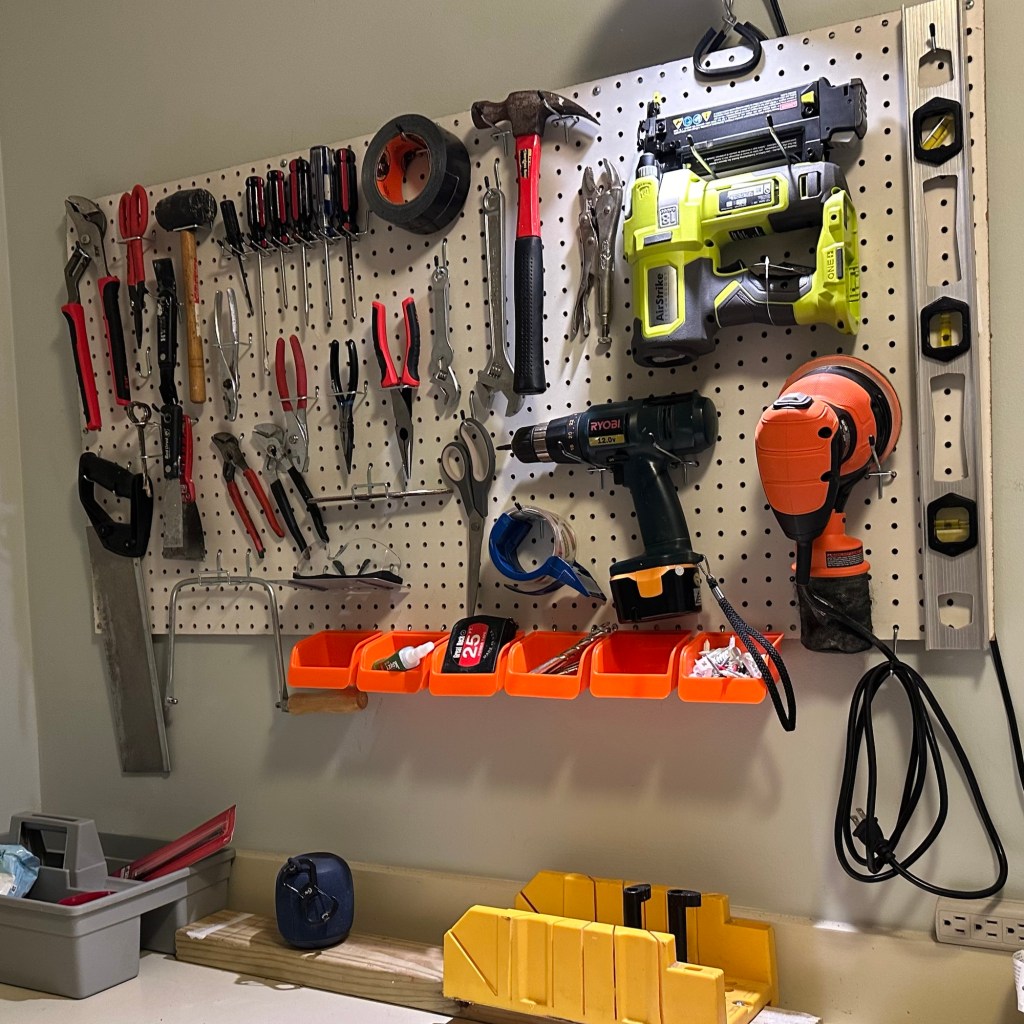
The internet is currently saturated with women remodeling their homes – I’m not special in that respect. What I am is thrifty and stubborn with an aging degree in architecture and a vicious creative itch. For my little dining room project I hammered every nail, sanded every surface, and hand-sawed every strip of batten. It’s grossly imperfect, but I did it all by myself, having spent as much mental capital on restraint as I did on sheer effort. It was a growth moment in honor of my 56th trip around the sun and the quiet beauty of self-reliance. Of course food was served.
 Foodishness